IRS Confirms $2,000 Direct Deposit for January 2026 – Know Your Exact Payment Dates and Eligibility Guide
IRS Confirms $2,000 Direct Deposit for January 2026 – Know Your Exact Payment Dates and Eligibility Guide
IRS Confirms $2,000 Direct Deposit for January 2026: As the new year settles in, a familiar phrase has returned to dinner-table conversations and social media feeds across the United States: an IRS $2,000 direct deposit in January 2026. The chatter has grown louder in recent weeks, driven by online posts, video explainers, and forwarded messages claiming that the Internal Revenue Service has begun issuing a one-time federal relief payment. For households already stretched by winter utility bills, lingering credit card balances from the holidays, and stubbornly high grocery prices, the possibility of fresh federal support has naturally caught attention.
What makes this discussion different from routine refund season speculation is the way the payment is being described. Unlike a tax refund or a credit adjustment, the January 2026 IRS $2,000 direct deposit is being framed as immediate relief, administered by the IRS but separate from annual filings. That distinction matters. It affects who might receive the money, how quickly it could arrive, and whether any action is required. Understanding the context behind these reports, and separating plausible policy moves from online exaggeration, has become essential for taxpayers trying to plan their finances early in the year.
Why the $2,000 Payment Conversation Has Resurfaced in 2026
The renewed focus on a potential IRS-issued payment did not emerge in a vacuum. Over the past year, economic indicators have sent mixed signals. While headline inflation has cooled compared to pandemic-era peaks, everyday costs such as housing, insurance, and healthcare remain elevated. Policymakers are under pressure to show responsiveness, especially during the first quarter of an election-adjacent year when public sentiment often hardens around cost-of-living issues.
Adding to this backdrop is the IRS’s expanded role in recent years. During earlier relief efforts, the agency proved it could distribute large-scale payments quickly using existing tax data. That operational memory has made the IRS a logical channel for any short-term support. As a result, even unconfirmed reports of an IRS $2,000 direct deposit for January 2026 feel believable to many Americans who remember similar mechanisms used just a few years ago.
How Eligibility Is Being Described and Who Stands to Benefit
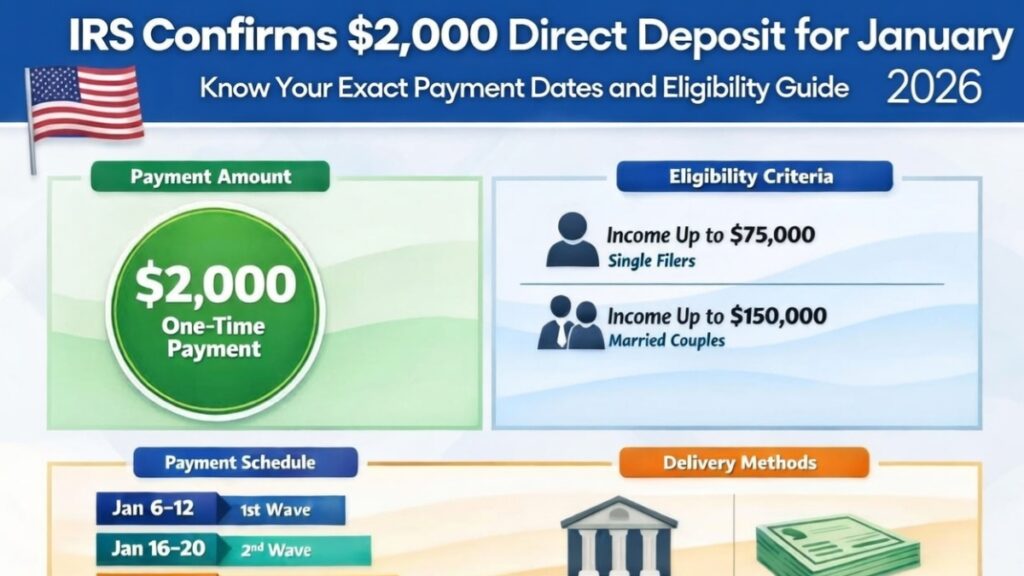
According to circulating details, eligibility for the January 2026 payment would rely heavily on recent tax filings rather than new applications. Income thresholds mentioned in reports mirror past relief structures, with full amounts linked to moderate earnings and gradual reductions above certain levels. This approach, if implemented, would allow the IRS to identify qualifying recipients quickly using 2024 or 2025 return data already on file.
The groups most often mentioned as beneficiaries include low- and middle-income workers, retirees with modest taxable income, and families managing dependents. “Targeted, one-time payments are politically and administratively easier than broad programs,” explains Rohan Mehta, a U.S.-based public finance analyst. “If such a deposit moves forward, it would likely aim at households where $2,000 genuinely changes month-to-month stability, rather than serving as a blanket payout.”
Payment Timing, Distribution Methods, and What January Could Look Like
One consistent element in these reports is the idea of staggered distribution. Rather than a single nationwide release, payments would be issued in waves throughout January 2026. Direct deposits are expected to go out first, reflecting the IRS’s long-standing preference for electronic delivery. Taxpayers who have received refunds via direct deposit in recent years would, in theory, be first in line.
Paper checks, if used at all, would likely follow later in the month. This phased approach helps manage processing loads and reduces the risk of system errors. It also explains why some households might see neighbors or relatives receive funds earlier. Similar patterns during past relief programs led to confusion and frustration, a lesson the IRS is keenly aware of as it balances speed with accuracy.
Comparisons With Past Relief Efforts and the Risk of Misinformation
The structure being discussed closely resembles earlier federal relief payments, but there are important differences. Previous programs were authorized through clear legislative packages, with formal announcements and dedicated IRS web pages. In contrast, the January 2026 IRS $2,000 direct deposit conversation has largely grown through secondary reporting and online sharing, creating fertile ground for exaggeration.
Consumer advocates warn that this environment often attracts scams. Messages promising “instant release” or asking for banking details are a red flag. “Any legitimate IRS payment is processed automatically,” notes Mehta. “The agency does not call, text, or email asking for sensitive information.” This distinction is critical as taxpayers navigate a flood of claims while waiting for official confirmation.
What Comes Next and How Households Should Prepare
In the absence of a formal IRS bulletin, financial planners are advising cautious optimism. Keeping personal information up to date with the IRS, particularly bank account details and mailing addresses, is a sensible step regardless of whether the payment materializes. These updates also help with routine refunds and credits during the 2026 tax season.
Looking ahead, analysts suggest that clarity will likely come through official channels rather than social media. If a payment is authorized, the IRS typically issues clear guidance outlining eligibility, timing, and common questions. Until then, households should treat the January 2026 IRS $2,000 direct deposit as a possibility, not a guarantee, and avoid making financial commitments based solely on unverified reports.
Disclaimer: This article is intended for informational and journalistic purposes only. It is based on publicly circulating reports and discussions regarding a potential IRS $2,000 direct deposit in January 2026 and does not constitute financial, legal, or tax advice. Government programs and payment policies can change without notice. Readers are encouraged to rely on official IRS statements and verified government sources for confirmation and to remain cautious of misinformation or unsolicited requests for personal details.