IRS Confirms $2,000 Direct Deposit for January, 2026 – Checkout Payment Dates and Eligibility Guide

IRS Confirms $2000 Direct Deposit for January
IRS Confirms $2,000 Direct Deposit for January: As Americans prepare to turn the calendar to 2026, a new financial development is drawing widespread attention: the IRS $2,000 direct deposit scheduled for January. For millions of households still navigating high grocery bills, stubborn rent increases, and medical expenses that refuse to cool down, this announcement has landed at a sensitive moment. While inflation has eased from its peak, everyday costs remain well above pre-pandemic levels, squeezing low- and middle-income families the hardest.
The January 2026 IRS payment is being positioned as a targeted relief measure rather than a sweeping stimulus like those seen during the pandemic years. Government officials have framed it as a response to lingering cost-of-living pressures, particularly for households that have not benefited proportionately from recent wage growth. With eligibility tied to recent tax filings and income thresholds, the payment is designed to move quickly, using IRS systems already in place. Understanding who qualifies, how the money will be sent, and why this approach matters offers insight into the government’s broader economic strategy.
Why the IRS $2,000 Direct Deposit Is Being Rolled Out Now
The backdrop to the IRS $2,000 direct deposit is a cautious economic recovery that looks uneven across income groups. While headline inflation numbers have cooled, essential expenses such as housing, insurance, and healthcare continue to rise faster than wages for many Americans. Policymakers have acknowledged that short-term relief remains necessary, especially for households that sit just above traditional assistance thresholds but still struggle to make ends meet.
Unlike earlier stimulus checks, this January 2026 IRS payment is not framed as emergency aid. Instead, it reflects a shift toward smaller, more targeted interventions. According to Washington-based economist Laura McKenzie, “This kind of payment signals that policymakers are trying to fine-tune relief—helping those most affected by inflation without overheating the economy.” The focus on existing tax data allows funds to move quickly while limiting administrative costs.
Eligibility Rules and Who Stands to Benefit Most
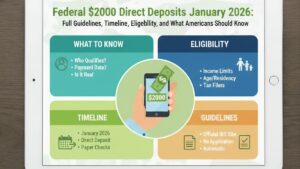
Eligibility for the January 2026 IRS payment is largely determined by adjusted gross income reported on recent tax returns. Single filers earning up to $75,000 and married couples filing jointly with incomes up to $150,000 are positioned to receive the full $2,000. These thresholds mirror earlier relief efforts, reinforcing a familiar framework for taxpayers and administrators alike.
Beyond income, residency and documentation matter. Recipients must have a valid Social Security number and must have lived in the United States for at least six months during 2025. Families with dependents may see higher overall household support, though high earners above the phase-out range will likely receive nothing. For many working families, especially those in service and healthcare sectors, this payment could cover a month’s groceries or offset winter utility bills.
January 2026 IRS Payment Timeline and Distribution Method
The IRS plans to distribute the $2,000 direct deposit in carefully timed waves throughout January 2026. Early January will see the first round of deposits land in bank accounts for taxpayers with direct deposit information already on file. This staggered approach is intended to prevent system overloads and reduce delays that plagued earlier mass payment programs.
Those without direct deposit details on record should expect paper checks later in the month. While slower, mailed checks remain a fallback option for millions of Americans, particularly seniors and low-income individuals without consistent banking access. Tax professionals advise checking IRS account details well before January, as even small errors can push delivery into February, diminishing the immediate impact of the relief.
How This Relief Compares With Past Federal Payments
Compared with the sweeping stimulus checks of 2020 and 2021, the IRS $2,000 direct deposit for January 2026 is narrower in scope. Earlier payments were designed to prop up an economy in free fall, while this initiative targets households still feeling aftershocks. The smaller scale reflects concerns about federal spending and inflationary pressure.
Still, the psychological impact should not be underestimated. Past relief payments showed that even modest cash infusions can stabilize household finances in the short term. Financial planner Marcus Hill notes, “For families living paycheck to paycheck, a one-time payment can prevent debt accumulation.” While it won’t solve structural cost issues, the payment may offer breathing room during a traditionally expensive season.
Public Reaction and What May Come Next
Public response to the January 2026 IRS payment has been mixed. Many welcome the assistance, viewing it as overdue recognition that inflation’s effects linger. Others question whether one-time payments address deeper problems like housing shortages and healthcare costs. On social media, some taxpayers have expressed frustration that eligibility cutoffs leave out those only slightly above income limits.
Looking ahead, analysts expect continued debate over targeted relief versus broader reforms. If economic pressures persist, similar payments could resurface, though likely with tighter criteria. For now, the IRS $2,000 direct deposit represents a cautious compromise—offering help without reopening the era of massive stimulus, and signaling how future support might be structured.
Disclaimer: This article is intended for informational and journalistic purposes only. Details regarding the IRS $2,000 direct deposit, including eligibility criteria and payment timelines, are based on publicly available reference information at the time of writing and may be subject to change.
Readers are encouraged to consult official IRS communications or qualified tax professionals for personalized advice. The publisher does not assume responsibility for decisions made based on this content, and no part of this article should be construed as legal or financial guidance.